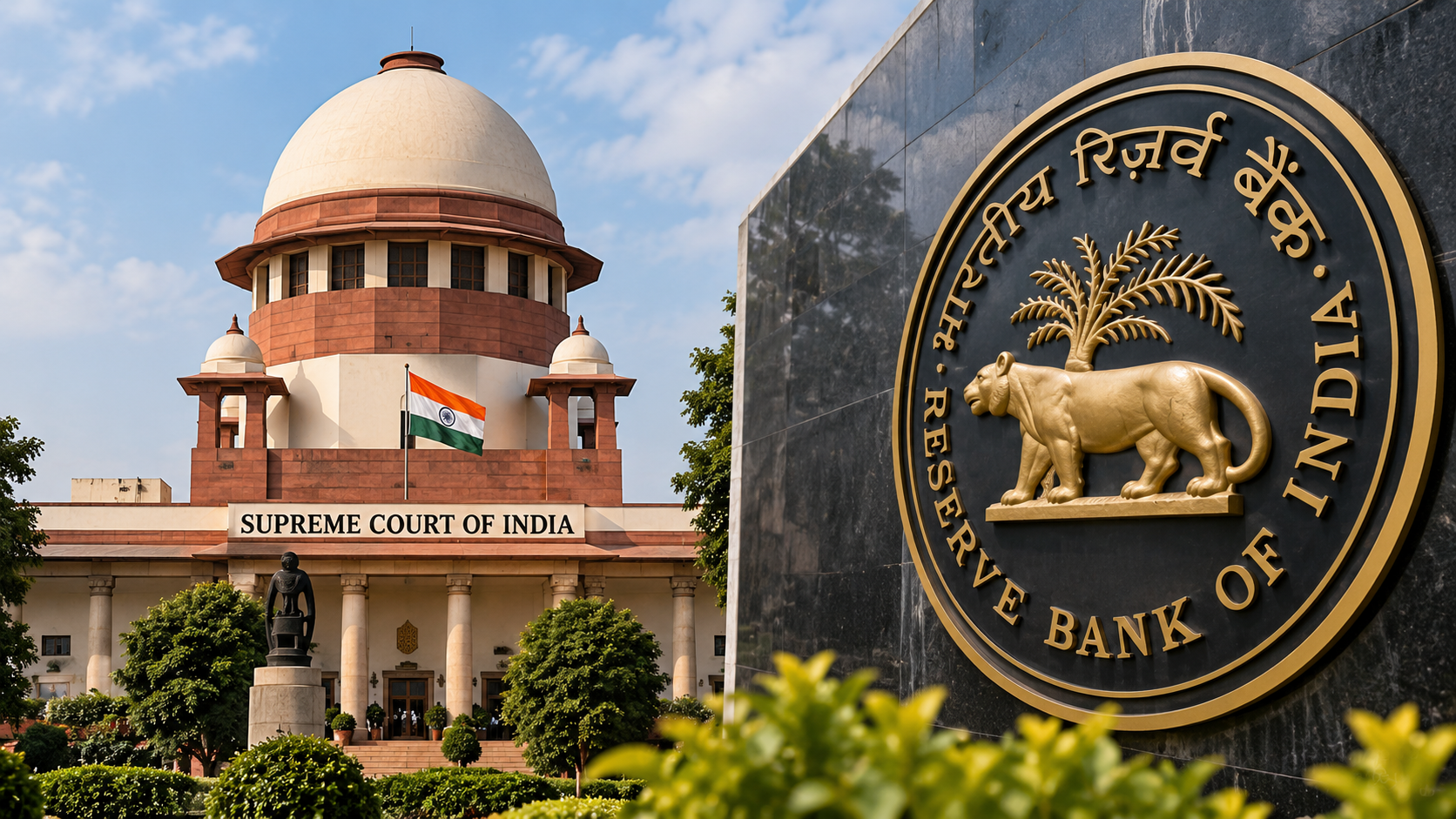
India’s Unified Payments Interface (UPI) has for years been associated with instant and largely cost-free digital payments. The Centre’s September 2026 decision to permit Merchant Discount Rate (MDR) on certain high-value UPI merchant transactions has now brought that model before the Supreme Court.
In Anjan Datta v. Union of India & Ors., registered as W.P.(C) Diary No. 57387/2026, a writ petition has been filed challenging the regulatory framework permitting MDR on specified UPI transactions above ₹2,000. The petition questions not merely the economic consequences of the framework, but also its statutory foundation, classification between different categories of digital payments, and the manner in which the charges and thresholds were determined.
The challenge comes against the backdrop of two significant developments by the Ministry of Finance and the subsequent announcement of the new MDR framework.
What has changed in the UPI framework?
On September 14, 2026, the Ministry of Finance issued Notification S.O. 5067(E) under Section 10A of the Payment and Settlement Systems Act, 2007. The notification specifies RuPay-powered debit cards and UPI transactions up to ₹2,000 as electronic modes on which banks and system providers cannot impose direct or indirect charges on persons making or receiving payments.
The significance of the notification lies in what it does not prohibit. Rather than maintaining a blanket statutory prohibition on charges for all UPI transactions, the protection is expressly limited to UPI transactions up to ₹2,000. This created the regulatory space for charges on certain transactions above that threshold.
The subsequent framework provides for MDR on specified person-to-merchant (P2M) UPI transactions exceeding ₹2,000. The standard MDR has been fixed at 0.4%, subject to a maximum of ₹300 for transactions of ₹75,000 or more. Certain sectors, including railways, telecommunications, insurance, fuel and agricultural inputs, are subject to a flat ₹5 MDR, while capital-market transactions carry a 0.02% rate capped at ₹300.
Importantly, this is not a general charge on every UPI user. Person-to-person (P2P) transactions remain free irrespective of the amount transferred. Merchant payments up to ₹2,000 also remain free, while small merchants covered by the zero-MDR framework continue to receive the exemption. The Government has stated that approximately 96% of merchant transactions will remain unaffected.
MDR is different from a direct consumer charge
One of the central distinctions in understanding the controversy is the difference between MDR and a transaction fee imposed directly on a consumer.
MDR is a fee associated with processing a merchant payment. It operates within the payment ecosystem and is distributed among participating entities such as banks and payment service providers. The Government has specifically clarified that MDR is neither a tax collected by the Government nor a charge collected by NPCI.
Under the announced framework, the charge is therefore placed within the merchant-payment ecosystem rather than directly imposed upon the individual making the payment. Banks have also been advised to ensure that merchants do not pass the MDR on to consumers, while UPI application providers have been prohibited from imposing platform fees or hidden charges on users.
However, the petition raises the question of whether a regulatory direction preventing merchants from passing on the cost is sufficient to eliminate the possibility of an indirect economic impact on consumers.
What does the petition challenge?
The petition filed by Advocate Anjan Datta challenges the framework on several grounds. One of its principal concerns is that although the charge is formally structured as an MDR payable within the merchant ecosystem, its economic consequences could extend beyond merchants.
According to the challenge, merchants may respond to the additional cost by incorporating it into their pricing structures, reducing their willingness to accept UPI payments, or adopting alternative payment practices. The petition therefore raises a broader question: can a financial burden imposed at one stage of a payment transaction be treated as having no impact on consumers merely because consumers are not directly charged?
The Government, on the other hand, has maintained that the framework is specifically designed to protect consumers and smaller businesses. It has emphasised that P2P transactions remain completely free, payments to merchants up to ₹2,000 remain free, and eligible small merchants continue to enjoy zero MDR.
Article 14 and the question of classification
A significant constitutional issue raised by the petition concerns Article 14 of the Constitution, which guarantees equality before the law and equal protection of the laws.
The new framework creates several classifications: transactions below and above ₹2,000; small and larger merchants; ordinary commercial transactions and specified essential sectors; and UPI transactions as distinguished from RuPay-powered debit-card payments.
The petition questions, among other things, why the ₹2,000 threshold was selected and why the monthly receipt threshold of ₹1 lakh determines eligibility for the small-merchant exemption. It also draws attention to the continued protection available to RuPay debit-card transactions irrespective of transaction value.
The constitutional question would therefore involve examining whether these classifications are based on an intelligible differentia and whether that differentia bears a rational relationship to the objective sought to be achieved.
The Government may, in contrast, rely upon the economic and regulatory distinctions between different payment instruments, merchant categories and transaction types, as well as the objective of maintaining the financial sustainability of the digital payment ecosystem.
At this stage, these are competing legal positions; the Supreme Court has not determined the validity of the classifications.
Article 19(1)(g) and the burden on merchants
The petition also invokes Article 19(1)(g), which protects the right to practise any profession or to carry on any occupation, trade or business.
The argument proceeds on the basis that mandatory MDR could impose an additional operational cost on merchants, particularly those operating on relatively thin margins. The petition reportedly questions whether the framework disproportionately affects smaller businesses and whether the thresholds and exemptions were supported by disclosed empirical material.
This raises a broader constitutional question concerning the extent to which economic regulation may affect the cost structure of private businesses. The existence of a financial burden by itself does not determine the validity of a regulation; the legal inquiry would also involve examining the statutory authority, nature of the restriction, classification adopted and the relationship between the measure and its stated objective.
The delegated legislation question
Another important aspect of the petition concerns the source of legal authority for the detailed MDR framework.
The September 14 notification derives its authority from Section 10A of the Payment and Settlement Systems Act, 2007. The petition, however, questions whether the subsequent fixation of rates, caps, sectoral categories and merchant thresholds has been undertaken through an adequately authorised and transparent statutory mechanism.
The issue becomes particularly significant because the MDR framework contains multiple economic classifications: a standard 0.4% rate, a ₹300 ceiling, sector-specific ₹5 charges, a separate rate for capital-market transactions and an exemption linked to merchant receipts.
The petition seeks greater disclosure of the material and methodology relied upon for determining these parameters and questions the role assigned to the UPI & Services Steering Committee in the process.
This places the case within the larger constitutional debate concerning delegated legislation and the permissible limits of executive regulatory power.
The Government's stated rationale
The Centre has presented the framework as an attempt to maintain the long-term sustainability of the UPI ecosystem while protecting individuals and small merchants from additional costs.
The Government has emphasised that UPI remains free for P2P transactions, that merchant payments up to ₹2,000 remain free, and that eligible small merchants continue to receive zero-MDR treatment. It has also stated that approximately 96% of P2M transactions will remain unaffected.
The framework is consequently not a blanket withdrawal of free UPI payments. Instead, it represents a move towards a differentiated payment-cost structure for specified high-value merchant transactions.
Why the ₹2,000 threshold matters
The ₹2,000 threshold is at the heart of the controversy.
Under the announced framework, a ₹2,000 eligible merchant transaction falls within the protected category, whereas a transaction above that threshold may attract MDR. The petition argues that such a threshold can produce what may be described as a “cliff effect”, where a relatively small difference in transaction value results in a substantially different regulatory consequence.
At the same time, the framework contains exemptions for small merchants and special treatment for certain sectors. Whether these distinctions are sufficiently supported by economic data and a rational regulatory basis is ultimately a matter for judicial consideration.
A question beyond UPI: how should digital infrastructure be funded?
The litigation also raises a larger policy question concerning India's digital-payment infrastructure.
UPI's expansion has created substantial infrastructure, cybersecurity, banking and payment-processing requirements. The traditional zero-MDR model encouraged adoption by keeping merchant payments inexpensive, but payment providers and financial institutions have also raised concerns regarding the sustainability of operating such an extensive payment network without transaction-linked revenue.
The new framework attempts to address this issue through MDR on a limited category of high-value merchant payments rather than imposing a universal user fee.
The legal dispute, however, is not simply about whether UPI infrastructure should have a cost. It concerns who should bear that cost, how the burden may be distributed, and whether the executive has adopted the legally permissible procedure for doing so.
What the Supreme Court may have to examine
The case potentially brings several interconnected questions before the Supreme Court:
- Whether the statutory framework permitting charges above ₹2,000 is constitutionally valid.
- Whether the classification between different UPI transactions satisfies Article 14.
- Whether the distinction between UPI and RuPay-powered debit-card transactions raises an equality concern.
- Whether the MDR framework places an impermissible burden on the freedom to carry on trade or business under Article 19(1)(g).
- Whether the rates, caps, thresholds and exemptions have adequate statutory backing.
- Whether the executive has followed the required procedure while determining the financial framework.
- Whether adequate empirical material and transparency existed for selecting the ₹2,000 and ₹1 lakh thresholds.
- Whether restrictions against passing MDR costs to consumers are sufficient to address the petitioner's concerns regarding indirect consumer impact.
The petition reportedly seeks production of relevant official records and challenges the MDR framework, while also seeking alternative relief in the form of a fresh, data-based consultation and review.
Conclusion
The litigation in Anjan Datta v. Union of India & Ors. places the changing economics of India's digital-payment infrastructure against questions of constitutional equality, delegated legislation and regulatory transparency.
The Government's framework does not impose a universal charge on UPI users. P2P transactions remain free, merchant payments up to ₹2,000 remain protected, and specified small merchants continue to receive zero-MDR treatment. At the same time, the framework permits MDR on specified high-value P2M transactions and therefore marks a significant departure from the earlier blanket zero-MDR approach.
The Supreme Court's eventual consideration of the challenge may therefore have implications extending beyond UPI. It could examine how far executive authorities can structure economic regulations through delegated powers, what degree of transparency is required when financial burdens are imposed, and how constitutional guarantees apply to differentiated economic regulation.
As of the latest available reports, the petition has been filed but the constitutional questions raised by it remain to be determined by the Supreme Court. The announced MDR framework is scheduled to take effect from 15 October 2026, subject to any subsequent judicial or regulatory intervention.


Comments (0)
Be the first to comment.
Leave a Comment